
20 4 月
A nation crisscrossed by 24,000 kilometres of waterways keeps choosing the more expensive, more polluting road , and the reasons why reveal something deep about how policy fails geography.
Economists have argued that modernising the country’s inland water logistics could raise GDP by 1% and expand trade volumes by 20%. Few development interventions of comparable scale carry that kind of arithmetic, and fewer still draw on assets that already exist. Bangladesh occupies one of the most hydrologically privileged positions of any developing economy. Approximately 24,000 kilometres of rivers, streams, and canals traverse the country, constituting one of the densest inland-waterway networks on earth. These waterways already carry close to half of all national freight tonnage, with well-documented structural advantages over road transport: lower cost per tonne, higher energy efficiency, and substantially reduced carbon emissions. And yet the country has steadily allowed road freight to displace river logistics as the dominant mode of moving goods. This is not a consequence of geography. It is a consequence of governance.
What explains this paradox is a convergence of three mutually reinforcing failures, each of which has received formal acknowledgment in policy circles without producing meaningful correction. The first is a persistent cost gap between road and river freight that has nonetheless failed to shift shipper behaviour at scale. The second is a physical infrastructure deficit, specifically the absence of functional intermodal terminals and reliably dredged channels, that renders the cheaper option practically unavailable to most shippers. The third is a pattern of chronic institutional underinvestment that successive planning cycles have diagnosed but not resolved. These failures do not operate in isolation. They constitute a self-reinforcing system in which the degradation of one dimension accelerates the deterioration of the others, and together they explain why one of the country’s most valuable economic assets remains, for the most part, idle.
The Arithmetic of the Absurd
Beyond the headline macroeconomic projections of GDP growth and higher trade volumes, the true scale of inefficiency becomes far clearer at the corridor level, where transport choices directly shape business costs. A 2022 analysis of the Chattogram-to-Dhaka corridor, the country’s most critical freight artery, found that moving cargo by truck costs around Tk 1,500 per tonne, while river barge transport costs roughly Tk 600 to Tk 650 per tonne. This represents a saving of approximately 55% to 60% for bulk and non-perishable goods. For containerised cargo, Mediterranean Shipping Company, through its 2025–26 engagement with the Pangaon Inland Container Terminal, has estimated cost reductions of 30% to 40%, even after accounting for terminal and handling charges.
These are not marginal efficiencies. They point to significant economy-wide gains if inland water logistics were modernised and integrated more effectively. Private-sector executives and development economists have therefore argued that such reforms could increase Bangladesh’s GDP by around 1% while expanding trade volumes by as much as 20%.
What makes this more striking is that these figures are neither speculative nor controversial. The numbers presented in Figure 1 are widely known across the logistics ecosystem. They are regularly cited by exporters, repeated in parliamentary committee discussions, and formally acknowledged within the government’s own National Logistics Policy 2025. The challenge, therefore, is not a lack of evidence or awareness. It is the persistent inability to convert well-established economic logic into functioning logistics infrastructure and commercial practice.
FIGURE 1
Freight Cost Comparison: Road vs. Inland Water
Selected routes and cargo types, Bangladesh, 2022–2026 estimates
| ROUTE / CARGO | ROAD COST (TK/TONNE) | RIVER COST (TK/TONNE) | SAVING | SOURCE |
| Chattogram → Dhaka (bulk, general cargo) | 1,500 | 600–650 | ~57% | Business Post BD, 2022 |
| Chattogram → Dhaka (containers, via PICT) | Market rate | 30–40% lower | 30–40% | MSC / Maritime Gateway, 2025–26 |
| Dhaka-bound containers (World Bank model) | Baseline | ~50–60% lower | 50–60% | World Bank / Financial Express |
| India–Bangladesh cross-border (agro, bulk) | Comparable road rate | Significant saving | Est. 40%+ | SASEC / ADB corridor study |
SOURCE: All figures are directional; exact savings vary by cargo type, vessel size, and terminal charges. Sources: Business Post BD; Maritime Gateway; Financial Express (Bangladesh); SASEC/ADB.
What makes these numbers so persistently inert as a policy lever is a combination of institutional inertia, the politics of road construction, and the absence of the intermodal infrastructure that would allow a shipper to move seamlessly from truck to barge and back. A single container barge, optimally loaded, can replace dozens of trucks. But without a proper terminal at each end, the barge is useless.
According to the Mordor Intelligence Bangladesh Freight and Logistics Market Study (2025), inland waterways and sea transport account for around 60.57 percent of total tonne-kilometres moved, making them the most efficient mode for bulk and long-distance movement. Despite this, they handle only 21.05 percent of total freight volumes, while road transport dominates with 68.75 percent of freight revenue share. This divergence exposes the central tension in Bangladesh’s logistics sector: efficiency and commercial reality are pointing in opposite directions.
The explanation for why road freight continues to dominate despite its higher cost is straightforward. Road infrastructure has received the bulk of infrastructure spending over two decades, producing a highway system that, however congested, is reliable. A shipper in Narayanganj, even when aware of lower per-tonne costs on waterways, continues to use road transport because there is no reliable and functional terminal infrastructure in Dhaka that can support seamless water-based freight movement. In such conditions, predictability, access, and last-mile convenience take precedence over theoretical cost efficiency.
The Infrastructure Gap
The second thread of the problem is physical. Rivers in Bangladesh are navigable to their full 6,000-kilometre monsoon extent for only half the year. In the dry season, siltation and low water levels reduce that figure to roughly 3,900 kilometres, cutting off routes that shippers have come to depend on. The 35 percent seasonal collapse in navigable waterway, shown in Figure 2, is presented as a natural constraint. It is more accurately described as a governance failure: the product of decades of deferred dredging rather than an immovable geographical fact.
FIGURE 2
Bangladesh’s Waterway Network: Monsoon vs. Dry Season
Navigable kilometres collapse by 35% in the dry season — a governance failure, not a geographic one
| MEASURE | KILOMETRES | NOTES |
| Total network | 24,000 km | Rivers, canals, streams |
| Navigable (monsoon) | 6,000 km | Full seasonal extent |
| Navigable (dry season) | 3,900 km | 35% reduction due to siltation |
| Target after dredging | ~6,200 km | $71M World Bank program, ongoing |
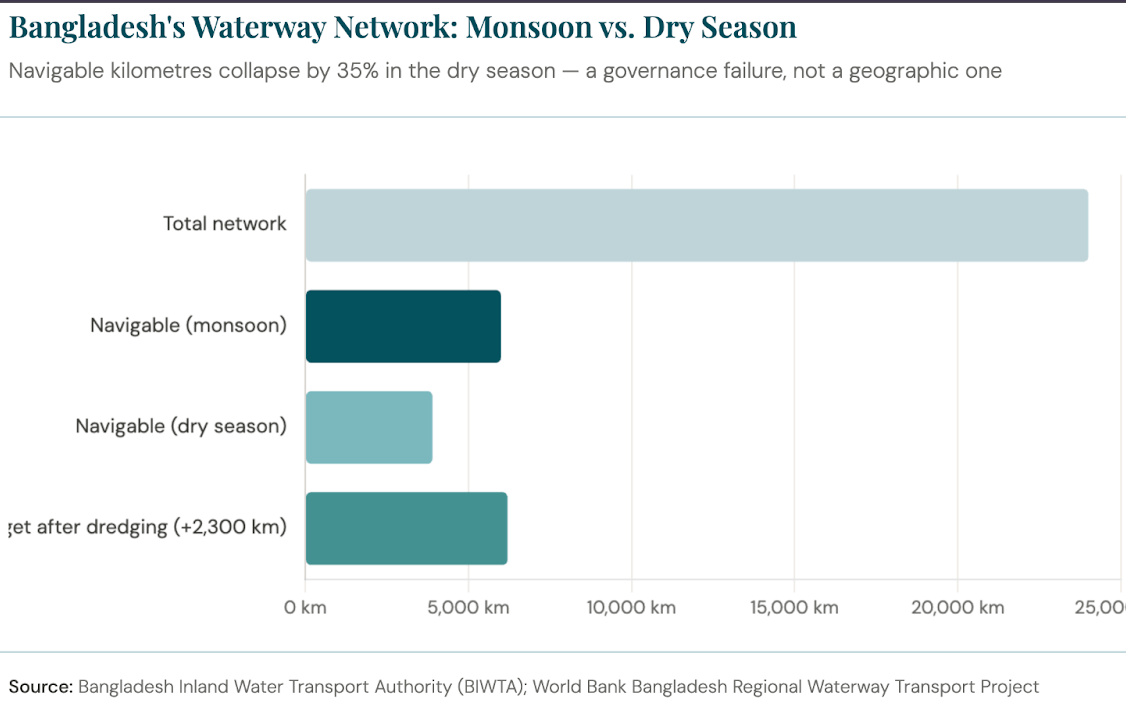
SOURCE: Bangladesh Inland Water Transport Authority (BIWTA); World Bank Bangladesh Regional Waterway Transport Project documentation, 2023–2026.
What renders this instrument latent is the absence of the intermodal infrastructure, mechanised terminals, dredged channels, and digital booking systems, that would permit cargo to move efficiently from road to barge and back. A shipper in Narayanganj who knows the per-tonne arithmetic with precision may still route his consignment by truck, because no functioning terminal at Dhaka offers him a credible alternative. The arithmetic, however clear, cannot substitute for infrastructure that does not exist.
The Pangaon Problem
Bangladesh’s only major inland river-port terminal, the Pangaon Inland Container Terminal on the Buriganga river south of Dhaka, illustrates both threads of this problem in a single case study. Built in 2013 at a cost of roughly Tk 15.5 billion, it was designed to handle 116,000 TEUs per year. For most of its existence it has operated at a fraction of that capacity, generating losses, deterring barging, and reinforcing the private sector’s instinct that river logistics was not a reliable proposition.
The reasons are instructive because the terminal lacks mechanised container-handling equipment. The channel upstream was also not dredged to accommodate larger barges. The trucking access roads that were supposed to create an intermodal yard never materialised at the scale the design envisioned. The result is a facility that encapsulates the wider failure: significant capital was spent, but the surrounding ecosystem of dredging, equipment, and access infrastructure was never completed, leaving the terminal unable to function as intended.
“Road freight from Chattogram to Dhaka is three times more expensive per tonne than river transport. Poor terminal infrastructure forces us to keep using trucks despite the cost and safety drawbacks.”
— Md Anwar Shawkat Afser, Managing Director, Sakhi Group in an interview with The Business Post in 2022
In January 2026, the government signed a 22-year concession agreement with MGL Bangladesh Private Limited, partnering with Chattogram Port Authority to modernise PICT, including expanded berths, mechanised equipment, and deeper channel dredging. MSC has signalled interest in using the terminal for river-based container hauls from Chattogram. Whether this marks a genuine turning point depends on whether the surrounding infrastructure, channel depth, and intermodal access follows.
What Sustained Investment Can Do: The Indian Precedent
The solution to seasonal navigability is neither novel nor beyond reach. India has already demonstrated it at scale, and the contrast with Bangladesh is instructive.
In 2013–14, India’s national waterways moved 18.1 million tonnes of cargo. By 2023–24, that figure had reached 133 million tonnes, a sevenfold increase in a decade. The drivers were not geographical luck. They were systematic: sustained capital investment in dredging, terminal development, cargo-incentive schemes, and a political decision to treat river freight as a strategic national priority. Twenty-six waterways are now operational. Figure 3 maps this trajectory against Bangladesh’s, which remains flat by comparison.
FIGURE 5
Figure 3: India’s Inland Waterway Freight: A Decade of Growth
Systematic dredging and policy commitment drove a 7× increase in cargo on India’s national waterways (2013–2024). Bangladesh’s trajectory remains flat by comparison.
| YEAR | INDIA NATIONAL WATERWAYS (MILLION TONNES) | KEY DRIVER |
| 2013–14 | 18.1 Mt | Baseline — 26 waterways designated |
| 2015–16 | ~28 Mt | Dredging and cargo incentive schemes |
| 2017–18 | ~55 Mt | NW-1 infrastructure investment |
| 2019–20 | ~72 Mt | Expanded terminal operations |
| 2021–22 | ~105 Mt | Intermodal integration deepens |
| 2023–24 | 133 Mt | 7× growth over baseline |
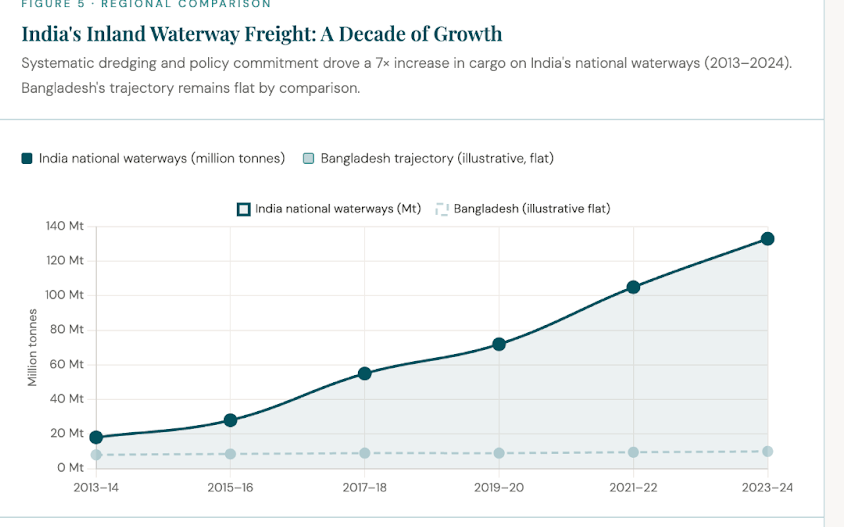
SOURCE: Press Information Bureau, Government of India, 2024 (PRID 2082758). Bangladesh trajectory is illustrative; based on absence of published comparable national waterway freight data reflecting sustained modal growth.
The infrastructure logic of India is identical to Bangladesh’s situation. Given that siltation is manageable, seasonal variation can be mitigated, and intermodal terminals are feasible. The India–Bangladesh shared waterway corridor, comprising eleven designated bilateral routes, of which only three are in regular operation, illustrates the same dynamic at the bilateral level. Environmental mismanagement and poor channel maintenance have rendered most routes unreliable, even where the political agreement to use them exists.
Bangladesh has begun responding. In 2023, the government awarded a $71-million World Bank-financed dredging contract targeting 2,300 additional kilometres of navigable waterway. A single trial shipment of high-value cargo from Kolkata to Pandu via the Bangladesh waterway demonstrated that the route works when it is maintained. The question is whether it will be maintained.
What the Evidence Points Toward
The case for Bangladesh’s inland waterways as a primary logistics corridor is, at this juncture, more robustly evidenced than it has ever been. The cost differentials are documented. The emissions advantage is quantified. The policy framework, in the form of the National Logistics Policy 2025, formally endorses the modal shift. The 2026 Pangaon concession and the ongoing World Bank dredging programme represent the most credible institutional commitment to the sector in a generation.
What will determine whether this moment translates into structural change is not just the quality of the evidence but the durability of political attention. Inland water transport does not generate the visible, legible kind of developmental progress that modern governments reward at the ballot box. Its value accumulates over years of channel maintenance, terminal investment, and intermodal integration, the unglamorous work of logistics governance that falls, consistently, below the threshold of political salience.
For Bangladesh’s exporters, the stakes of continued deferral are rising. European and American buyers are intensifying their scrutiny of supply-chain emissions. Inland waterways offer a credible low-carbon logistics pathway at competitive cost, a combination that should, under any rational framework, generate strong commercial and policy incentives for rapid development. The network already exists. The demand already exists. The financial case is unambiguous. What Bangladesh’s rivers await is not discovery. They await the administrative will to be used.
References
- Bangladesh Inland Water Transport Authority. (n.d.). Bangladesh Inland Water Transport Authority. Banglapedia. Retrieved April 20, 2026, from https://en.banglapedia.org/index.php/Bangladesh_Inland_Water_Transport_Authority
- Bangladesh Inland Water Transport Authority & Chittagong Port Authority. (n.d.). 关于. Pangaon Inland Container Terminal. Retrieved April 20, 2026, from https://pict.gov.bd/about/
- Business Post. (2022). Road freight from Chattogram to Dhaka is three times more expensive per tonne than river transport [article referenced in your draft]. Retrieved April 20, 2026, from the Business Post website.
- Chattogram Port Authority. (2026). Pangaon Inland Container Terminal: About / project information. Retrieved April 20, 2026, from https://pict.gov.bd/about/
- CUTS International, Centre for International Trade, Economics & Environment (CITEE). (n.d.). 孟加拉国 [PDF]. Retrieved April 20, 2026, from https://cuts-citee.org/pdf/IW_Bangladesh_Report.pdf
- Dhaka Tribune. (2023, September 11). BIWTA falling short of target to restore abandoned waterways. Retrieved April 20, 2026, from https://www.dhakatribune.com/bangladesh/325087/biwta-falling-short-of-target-to-restore-abandoned
- Government of Bangladesh. (2025). National Logistics Policy 2025 [policy document]. Retrieved April 20, 2026, from the Government of Bangladesh / published coverage links in Bangladeshi media.
- Maritime Gateway. (2022, August 14). Indo-Bangla waterways see more cargo traction. Retrieved April 20, 2026, from https://www.maritimegateway.com/indo-bangla-waterways-see-more-cargo-traction/
- Mordor Intelligence. (2025). Bangladesh freight and logistics market study 2025 [market report]. Retrieved April 20, 2026, from Mordor Intelligence.
- Press Information Bureau, Government of India. (2024). India’s inland waterways freight growth / national waterways update [press release]. Retrieved April 20, 2026, from the Press Information Bureau website.
- SASEC. (2020, January 19). Commentary: Inland waterways – Positive impact on economy. Retrieved April 20, 2026, from https://www.sasec.asia/mailout.php?page=news&nid=1118&url=inland-waterways-positive-impact&enews=74
- The Business Post. (2022). Interview with Md Anwar Shawkat Afser, Managing Director, Sakhi Group [article referenced in your draft]. Retrieved April 20, 2026, from https://www.tbsnews.net/
- The Daily Sun. (2016, March 29). BIWTA to restore navigability of 18000 km waterways. Retrieved April 20, 2026, from http://www.daily-sun.com/post/124552/BIWTA-to-restore-navigability-of-18000-km-waterways
- The Daily Sun. (2025, November 5). National Logistics Policy 2025 approved to boost investment [reporting on policy approval]. Retrieved April 20, 2026, from https://www.daily-sun.com/post/838356
- The Financial Express. (n.d.). Bangladesh logistics / inland waterway reporting cited in draft. Retrieved April 20, 2026, from The Financial Express website.
- The World Bank. (2016–2025). Bangladesh Regional Waterway Transport Project [project documents]. Retrieved April 20, 2026, from https://documents1.worldbank.org/curated/en/101171568294166006/pdf/Bangladesh-First-Regional-Waterway-Transport-Project-Better-I…
- The World Bank. (2020, July 12). Reviving Bangladesh’s in-land waterways for low-carbon and resilient transport. Retrieved April 20, 2026, from https://www.worldbank.org/en/news/feature/2020/07/12/reviving-bangladeshs-in-land-waterways-for-low-carbon-and-resilient-transport
- Transport Links. (2024, July 31). Country scoping of research priorities on low-carbon transport in Bangladesh. Retrieved April 20, 2026, from https://transport-links.com/hvt-publications/country-scoping-of-research-priorities-on-low-carbon-transport-in-bangladesh