
22 4 月
PROJECT CONTEXT Inspira Advisory and Consulting Ltd., in collaboration with Swisscontact under the Building Youth Employability Through Skills (BYETS) project, was engaged to design initiatives for strengthening youth employability and entrepreneurship across Bangladesh. Through Entrepreneurship Development Bootcamps delivered across Khulna, Rajshahi, Natore, Jashore, and Satkhira, 427 young participants were trained across 17 sessions. More than half entered the programme already on the threshold of starting or growing a business. Beyond the bootcamps, Inspira worked alongside Training Service Providers (TSPs) to deliver business development planning, mentorship, and market linkages, ensuring that support followed participants into the real terrain of building a business long after the sessions ended.
In the rural upazila of Puthia in Bangladesh’s Rajshahi district, Md. Imon Ali produces one of the country’s most distinctive and sought-after traditional goods: khejur gur, a golden date palm molasses harvested each winter from trees his family has tended for generations. The product carries centuries of cultural significance across Bengal, and today it sits at the intersection of something much larger: a global jaggery market valued at USD 7.2 billion, growing at a compound annual rate of 5.8%, driven by rising demand for natural, minimally processed sweeteners among health-conscious consumers worldwide.
Yet for Imon, like most small producers of khejur gur, the product’s reach ended where the local market began. Each season, his family earned between 80,000 and 90,000 BDT selling exclusively in Puthia and Rajshahi Sadar. The buyers were loyal. The market was small. And the gap between what the product was worth and what it was earning had never been closed, not because demand was absent, but because the pathway to it was.
This is the challenge that the BYETS project, executed by Inspira Advisory and Consulting Ltd. in collaboration with Swisscontact, was designed to address: not just building individual skills, but building the market infrastructure that connects quality producers to the buyers who want their products.
Imon is also a university student, which added its own layer of constraint. During date season, his semester examinations arrived on the same schedule. Travelling to Rajshahi Sadar to sell at the market meant losing study days he could not afford to lose. Staying home meant watching the season pass with stock sitting unsold. The product his family had built over generations was stranded between two calendars. But the deeper problem was not time: it was that the entire business model depended on physical presence in a local market, with no infrastructure to serve buyers anywhere else.
Building the Entrepreneur, Not Just the Skill
Imon’s entry into the BYETS programme began through the Entrepreneurship Development pathway. After participating in training sessions on digital skills, including graphic design and information and communication technology, he stood out not as someone seeking freelance work, but as someone with a concrete product and the ambition to build a competitive business around it.
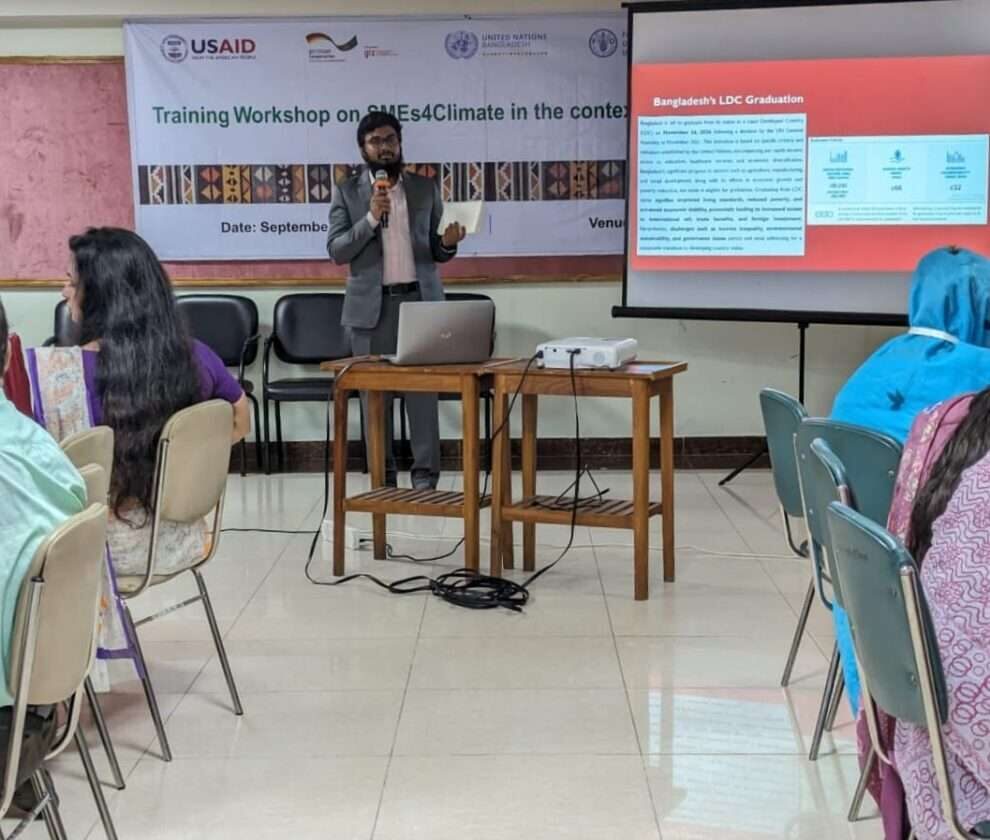
Inspira identified such aspiring entrepreneurs through a structured application process that assessed business interest, prior experience, and entrepreneurial motivation. Through this process, Imon was selected for the Entrepreneurship Development Bootcamp, where over seven days he received focused training on business ideation, competitor analysis, branding, marketing, and business development planning.
It was through this bootcamp that he learned about the Business Support Hotline, an ongoing advisory mechanism developed by Inspira that allowed participants to seek practical guidance by phone or text as they encountered real challenges in building a business. The hotline was not a general helpdesk. It was a structured connection to business development expertise, designed to be accessible from wherever a participant happened to be operating.
From Local Product to National Market
When Imon reached out through the hotline, a business development expert assessed his situation and introduced a direction he had not previously considered: f-commerce, the practice of selling through Facebook-based marketplace communities, and Bangladesh’s active and growing online buying-and-selling ecosystem. The guidance was specific and actionable. Imon learned how to present his product digitally, write listings that would attract the right buyers, and interact effectively in online communities where demand for traditional and artisanal food products was already strong.
He was also guided on how to use existing delivery and logistics services to fulfil orders across the country, removing the need for physical market visits entirely. The bootcamp and subsequent mentoring gave him both the tools and the operational confidence to function as a national seller from Puthia, without leaving home.
Imon followed through. Within one week of listing his molasses on the platform, he had earned close to 1.5 lakh BDT, nearly double his entire usual seasonal income, while continuing his studies. Buyers from Dhaka, Chattogram, Sylhet, and beyond placed orders for a product that had never before left the Rajshahi division. The khejur gur from Puthia had found a national market, and Imon had found a way to run his business entirely on his own terms.
A Model Worth Scaling
What Imon’s story illustrates is not simply a personal success. It reflects a structural opportunity. Bangladesh produces a wide range of niche, high-quality traditional products with strong domestic demand and growing international interest, particularly among Bengali diaspora communities in the United Kingdom, the United States, and the Middle East, where authentic khejur gur is actively sought but difficult to source. Most producers, however, lack the digital tools, market knowledge, and business infrastructure to move beyond their immediate geography.
Inspira’s is working on building exactly that infrastructure: identifying producers with viable products, equipping them with the business and digital skills to compete in broader markets, and connecting them to the buyers who are already waiting. In doing so, it is not creating new demand. It is closing the gap between demand that exists and producers who have never had a route to reach it.
Imon Ali is one of those producers. His khejur gur is now reaching buyers across Bangladesh. The next step, with the right support on packaging, quality assurance, and export pathways, could take it further towards the global markets.