

26 5 月
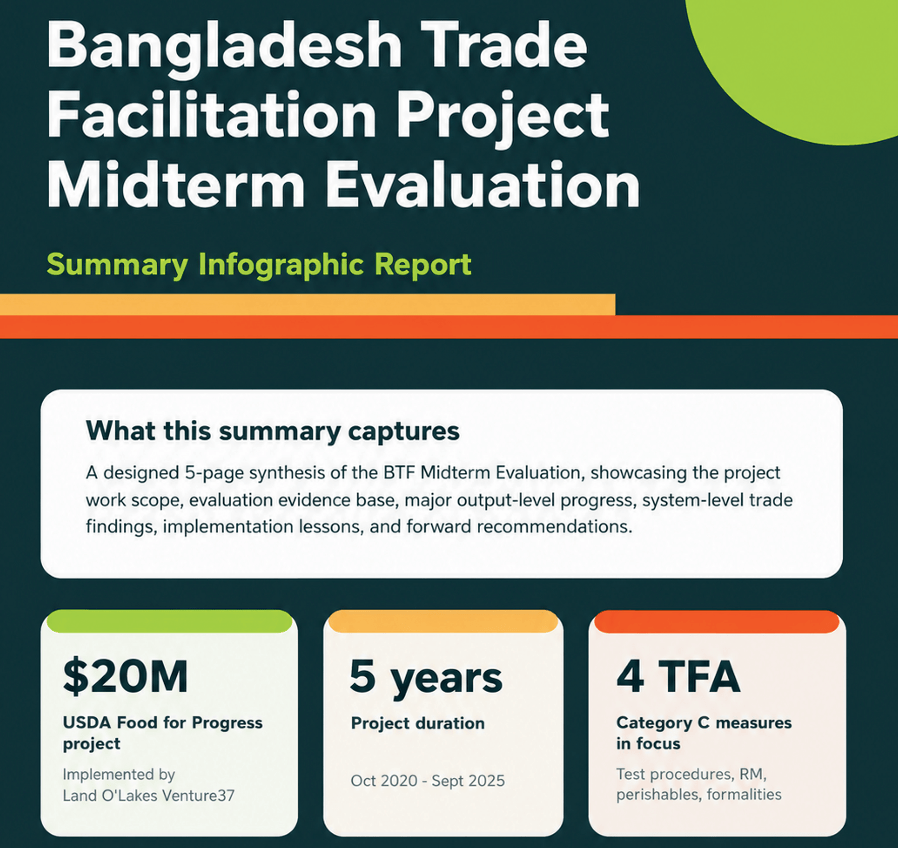
The Bangladesh Trade Facilitation Project is a five-year, USD 20 million initiative designed to improve trade systems, reduce procedural barriers, and strengthen agricultural trade facilitation in alignment with WTO Trade Facilitation Agreement priorities. The midterm evaluation covers four major focus areas: test procedures, risk management, perishable goods, and formalities. It assesses project work across legal and regulatory reform, trade information transparency, risk management systems, laboratory and testing procedures, and cold-chain infrastructure. The evidence base includes 72 key informant interviews, 218 trader and C&F agent surveys, three gemba walks, and four assessment lenses covering process, institutional, system, and implementation performance.
By the midpoint, the project had made visible progress in policy reform, automation, institutional capacity building, laboratory strengthening, and cold-chain investment facilitation. Key achievements include support for 28 policies, regulations, or procedures; creation or improvement of four systems; improved performance across 11 organizations; installation of temperature-controlled logistics capacity; and leveraged private investment. At the same time, the summary identifies important implementation constraints, including the absence of a single government lead agency, delays in formalizing agreements, policy reform complexity, leadership dependence, infrastructure gaps, market uncertainty, and limited user familiarity with advanced trade concepts. The recommended priorities for the remaining project period include strengthening the national trade facilitation mandate, securing ownership of trade information systems, advancing risk-based compliance, expanding laboratory networks, increasing private-sector uptake, and addressing cold-chain and monitoring gaps to improve long-term sustainability and trader utilization.
Download Full Report Here
报错: 未找到这个表单