
06 Jan
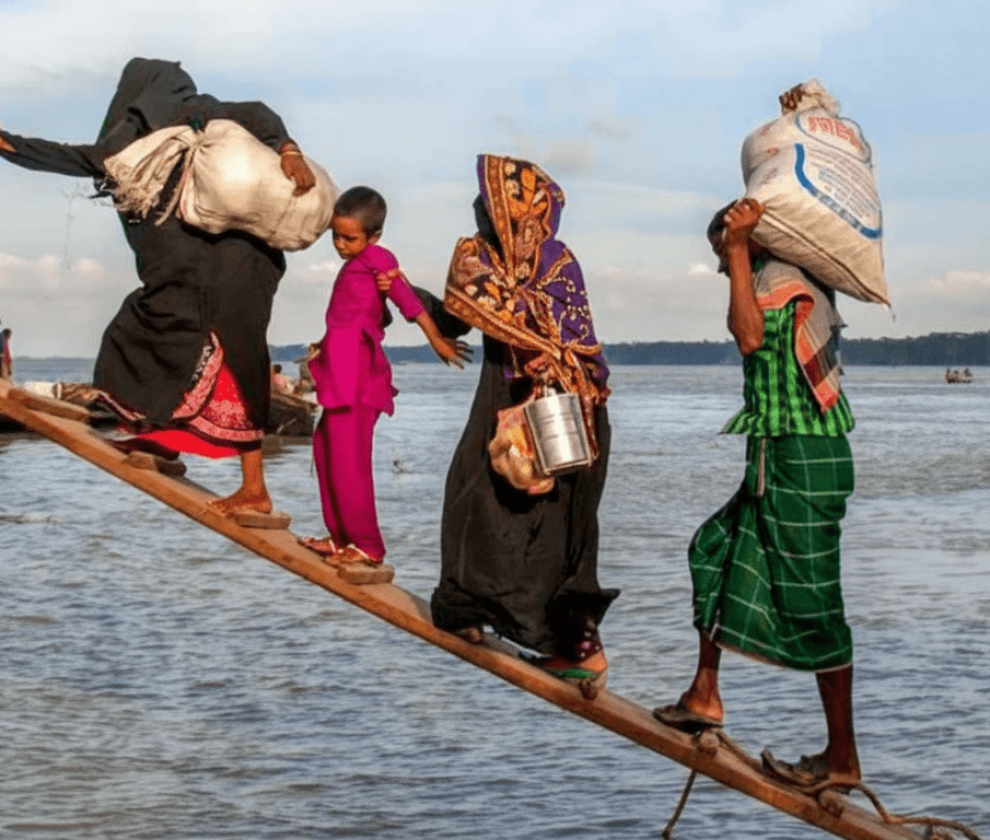
By 2050, floods, cyclones, and river erosion could displace an estimated 19.9 million people in Bangladesh. Behind this number are families forced to leave the places that shaped their homes, livelihoods, and communities seeking the nearest place of safety. In these moments, megacities like Dhaka and Chittagong, despite dominating migration discussions remain out of reach for many displaced families.
High living costs, intense competition for jobs, and limited access to housing make megacities financially inaccessible for climate migrants. They are also geographically distant from many coastal communities, and in moments of floods or river erosion, families tend to seek refuge in nearby areas rather than migrate long distances in search of opportunity. As a result, climate migrants often move to secondary cities such as Rajshahi, Sirajganj, Satkhira, Barishal, Khulna, Mongla, and Bagerhat in search of a better life.
Importance of Secondary Cities
Secondary cities which are larger than rural towns but smaller than megacities serve as important urban hubs that offer employment opportunities and social networks to climate migrants. Their relatively lower housing costs, smaller populations, and growing markets make relocation more feasible for displaced families, while local networks and NGOs can provide critical social and legal support.
For many climate-displaced families in Bangladesh, these cities have therefore become the first point of refuge, offering a chance to rebuild their lives without the crushing pressures of megacities. Yet, despite this role, not all secondary cities remain structurally prepared to absorb the scale and complexity of climate displacement. Many of these cities have significant gaps persisting across their support systems.
Challenges in Support Systems
For families arriving in secondary cities, there is a daily struggle to survive in environments that cannot adequately receive them.
Firstly, most climate migrants settle in overcrowded informal settlements, also known as “urban slums,” where limited access to clean water, sanitation, and waste management exposes them to recurring disease outbreaks and constant threats of eviction. In places such as Rupsha slum of Khulna, these evictions often wipe out the few possessions migrants manage to carry with them. Moreover, the steady influx of young rural migrants expands an already saturated low-skill labor market of the host community. Thus, intensifying competition and pushing down wages in informal sectors such as rickshaw pulling. For people with disabilities, mobility barriers and unsafe urban conditions severely limit access to factory-based employment. Small producers, meanwhile, struggle to survive in exploitative informal markets, where middlemen capture most of the value and irregular earnings push families into high-interest debt—a pattern seen among households in Satkhira following Cyclone Amphan.
Secondly, there is a legal and administrative invisibility of climate migrants in some cities that further deepen these hardships. Rapid displacement from disasters such as Cyclone Amphan in 2020 left millions without formal identification or proof of residence. These exclude them from jobs, public services, and financial systems. For example in Khulna, evicted slum dwellers from nearby Jessore continue to live without verified residency, which limits any pathway to stability or integration.
Thirdly, for women and girls, displacement compounds existing social inequalities. Gender-based violence, child labor, and the stigma of being labeled “outsiders” erode their dignity and agency within host communities. Seasonal unemployment during monsoons further forces families into desperate coping strategies, including child begging, trapping households in cycles of intergenerational poverty without access to skills, training, or markets.
Together, these overlapping vulnerabilities place immense pressure on already overstretched urban services, which intensifies competition over housing and jobs in secondary cities. The result is not only deteriorating living conditions for climate migrants but also widening economic and social divides of the host communities. Without locally coordinated support systems, adaptation efforts remain disconnected from lived realities.
Local Approaches to Resilience
Amid the challenges faced by climate migrants, some recent stories of local adaptation techniques offer signs of hope. For example, last year in Satkhira, a community group funded by direct local grants built saline-tolerant shrimp ponds, slashing migration by 30% as families stayed put post-floods. This was living proof that local control works.

Source: Seafood Network Bangladesh
Stories of diversified farming and micro-insurance, enabling families to stay in place despite cyclones and salinity are also not new which have reduced migration influx from coastal areas. Likewise, local leadership ensures solutions fit cultural and geographic realities, breaking cycles of displacement and urban slum growth . It does so by including local, indigenous, and scientific knowledge to understand the associated risks and allocating available resources. Locally led adaptations also have seen to be bypassing bureaucratic hurdles for sustained impact and providing long-term, predictable funding directly to local actors.
Similarly, reversing the flow of migrants by funding community-driven efforts like saline-tolerant crops, raised housing, and cyclone shelters in places like Satkhira or Khulna, is needed to reduce their migration patterns.
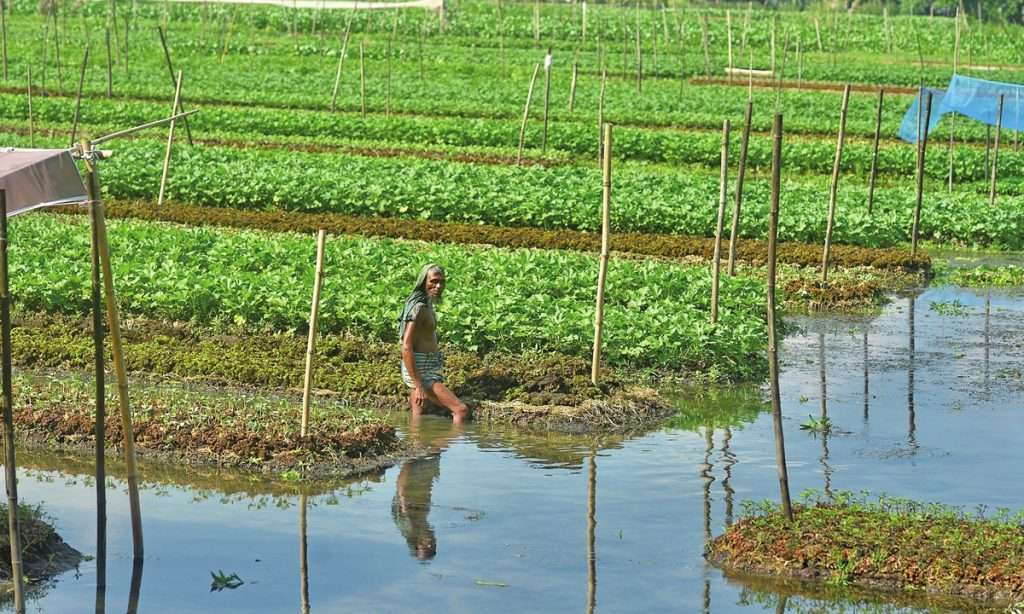
Salt-Tolerant Crop Fields in Khulna
Source: Global Times
This approach fosters livelihood strategies such as diversified farming and micro-insurance, enabling families to stay in place despite cyclones and salinity. Building on this, climate migrants from Rajshahi, Sirajganj, Barishal, Mongla, and Bagerhat could also develop their locally led adaptation techniques to prioritize local agency and knowledge.
Lessons from Global Climate Migration Pathways
Across the world, countries facing climate displacement have learned that integration does not happen automatically; it is designed. To help the millions of climate-displaced people in Bangladesh, secondary cities need coordinated strategies that address legal, social, and economic barriers.
When looking at Vietnam, they have shared branding and platform-based approaches that connect migrants to stable value chains and help prevent the perpetuation of slum economies. Key initiatives also include Public–Private–Producer Partnership (4P) platforms, Common Interest Groups (CIGs), and the One Commune One Product (OCOP) initiative, which Bangladesh can learn from.
Again, India’s neighbourhood-based modular training allows women to build livelihoods without abandoning care roles. At the same time, adaptive jobs like stationary retail and record-keeping include people with disabilities. These designs prioritise task flexibility over significant investments, fostering economic participation.
In countries managing large displaced populations, flexible finance has proven critical where formal banking systems fall short. In Uganda, refugee-hosting districts allow displaced households to access group-based lending through savings and credit cooperatives (SACCOs), replacing collateral with social guarantees. Additionally, Bangladesh’s secondary cities can mirror Indonesia’s NGO and community city partnerships like the “One Bridge” of Oxfam and Kupas, enabling vulnerable coastal settlements to access financial services and livelihoods before formal IDs are issued.
Climate migration is inevitable, but can we adapt, mitigate, and manage its impacts locally?
With the right systems in place, migration can drive inclusive and resilient development with resources that are available locally. After all, 19 million displaced people represent 19 million potential entrepreneurs, workers, and innovators.
There is an urgent need for evidence-based research that goes beyond population counts to examine how climate migrants access housing, jobs, health care, finance, and social protection in secondary cities over time. Disaggregated data is essential to design inclusive policies that reflect lived realities rather than assumptions. Research must also evaluate what works: which locally led adaptation models reduce distress migration, which livelihood strategies enable stability, and which service delivery mechanisms are scalable across urban contexts.
Besides, sustainable solutions require targeted and predictable funding which is not short-term. Investment must be directed toward strengthening municipal capacity, expanding inclusive housing and infrastructure, enabling flexible finance, and supporting community-led solutions that respond to local conditions. Channeling resources directly to local governments and actors will be key to translating policy into impact.
If Bangladesh is to turn climate migration from a crisis into an opportunity, secondary cities must be equipped not just to receive migrants, but to support them with dignity. This demands stronger evidence, clearer policy commitment, and sustained investment now, before displacement overwhelms systems that are already stretched to their limits.
References
- https://www.migrationpolicy.org/article/bangladesh-india-climate-migration
- https://icccad.net/publications/policy-briefs/building-climate-resilient-migrant-friendly-cities-and-towns/
- https://www.tbsnews.net/supplement/rajshahi-will-be-city-entrepreneurs-5-years-363544
- https://www.giz.de/de/downloads/giz2023-creating-inclusive-urban-opportunities-for-climate-migrants.pdf
- https://www.tbsnews.net/bangladesh/environment/climate-change/climate-migrants-5-cities-see-their-livelihood-opportunities
- https://www.aa.com.tr/en/asia-pacific/climate-change-displaced-millions-of-bangladeshis-in-2022-who/2750491
- https://www.wateraid.org/bd/addressing-resilience-losses-of-climate-induced-migrants-in-southwest-bangladesh-affected-by-the
- https://www.giz.de/en/projects/urban-management-internal-migration-due-climate-change
- https://www.sciencedirect.com/science/article/pii/S2405844022006430#bib19
- https://www.thedailystar.net/news/bangladesh/news/climate-displacement-debt-traps-3858546
- https://www.uncclearn.org/wp-content/uploads/library/makassar_indonesia_-_climate_change_vulnerability_assessment.pdf
- https://documents1.worldbank.org/curated/en/974061655323723062/pdf/India-Rights-Inclusion-Accessibility-and-Opportunities-for-Persons-with-Disabilities-in-Tamil-Nadu-Project.pdf
- https://webapps.ifad.org/members/eb/143/docs/EB-2024-143-R-3-Project-Design-Report.pdf
- https://www.e-mfp.eu/post/the-network-perspective-financial-inclusion-for-refugees-and-host-communities-in-uganda
- https://gca.org/programs/locally-led-adaptation/
- https://journals.sagepub.com/doi/10.1177/09562478221149863
- https://icccad.net/programmes/lla-programme/